PFAS Removal from Industrial Wastewater: Over 99% PFAS Reduction at Chemours Dordrecht

PFAS Removal from Industrial Wastewater: Over 99% PFAS Reduction at Chemours Dordrecht

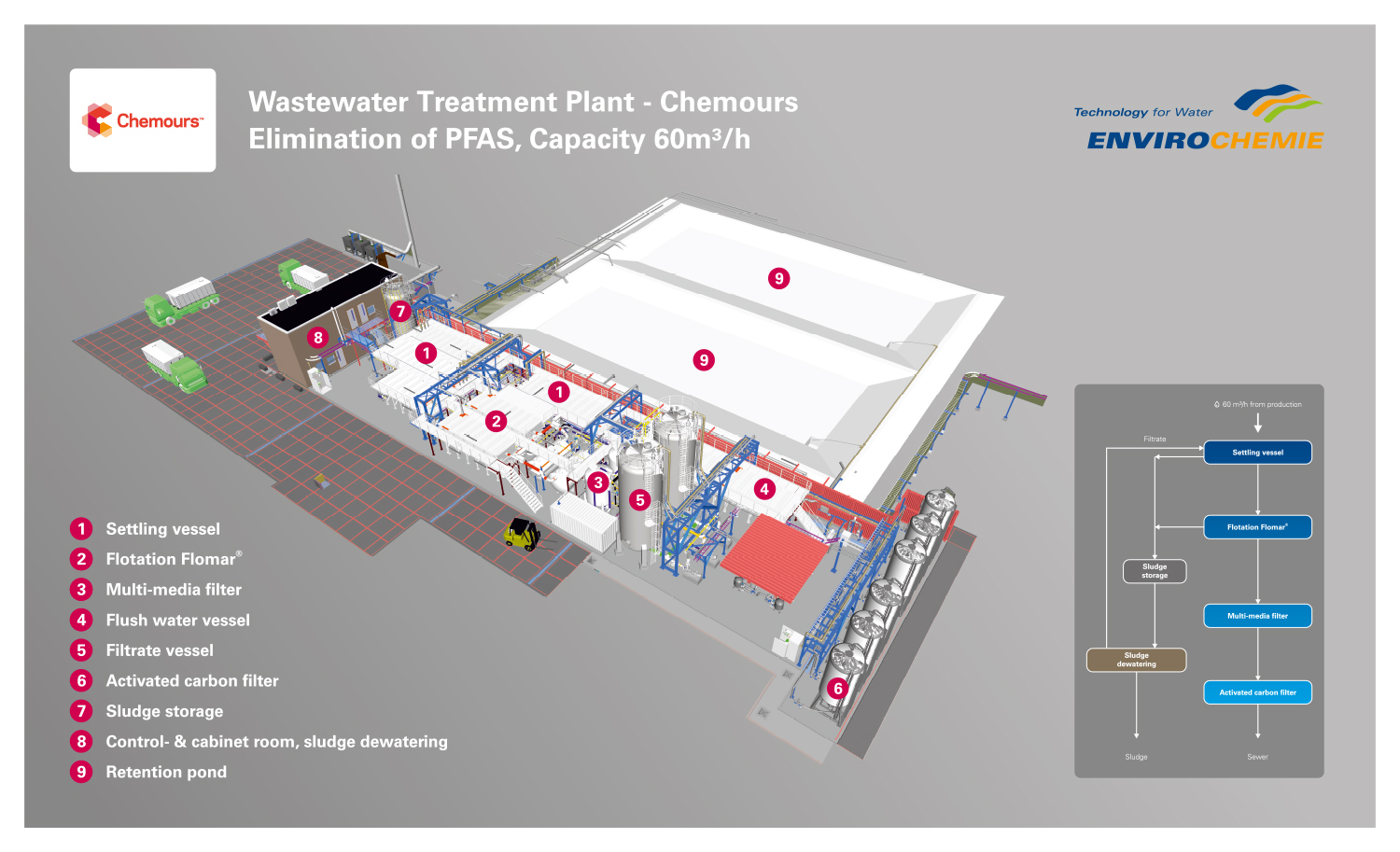
Per- and polyfluorinated alkyl substances (PFAS) are among the most persistent industrial chemicals and pose significant challenges for industrial wastewater treatment. At the Chemours site in Dordrecht, Netherlands, EnviroChemie implemented a high-performance plant for PFAS removal from wastewater. The treatment system reliably removes PFAS compounds—particularly GenX—from industrial effluents. The plant treats an average of 1,440 m³ of wastewater per day and achieves a PFAS reduction of over 99%.

What we did

EnviroChemie designed, implemented, and commissioned a multi-stage wastewater treatment plant at the Chemours Dordrecht site in the Netherlands for the removal of fluorinated organic compounds (PFAS) from industrial wastewater. The objective of the project was to ensure reliable PFAS treatment in compliance with stringent Dutch discharge regulations for surface waters.

The treatment system combines mechanical separation processes, physico-chemical treatment, and advanced filtration technologies. This multi-stage approach effectively removes PFAS compounds and other fluorinated organic substances from industrial wastewater, ensuring compliance with required discharge limits.

  • Task

    Task

    The production of fluoropolymers generates industrial wastewater containing PFAS compounds—particularly GenX. These per- and polyfluorinated alkyl substances are highly stable chemically and are difficult to remove using conventional wastewater treatment methods.

    For the Chemours Dordrecht site, a high-performance solution for PFAS treatment was required. The goal was to achieve reliable PFAS removal while continuously treating large volumes of wastewater and ensuring full compliance with regulatory environmental requirements.

    The new wastewater treatment plant replaces a temporary treatment solution and ensures stable operation at average flow rates of 60 m³/h, with peak flows of up to 120 m³/h.

  • Solution

    Solution

    The PFAS-containing industrial wastewater first passes through sedimentation tanks to remove coarse and settleable solids. A polyelectrolyte is then dosed to aggregate fine particles into flocs, which can be separated from the wastewater.

    These flocs are efficiently removed using dissolved air flotation (Flomar®).

    The pre-treated wastewater is subsequently processed through sand filters and activated carbon filters. This filtration stage reliably retains and removes PFAS compounds—particularly GenX—from the wastewater.

    A key design feature of the plant is the use of hopper-bottom tanks equipped with integrated screw conveyors, which automatically remove PFAS-containing sludge. The resulting sludge is then dewatered using a decanter and safely handled for further treatment.

  • Benefits

    Benefits

    The plant ensures reliable and continuous treatment of PFAS-containing industrial wastewater with high purification efficiency. With a PFAS reduction of over 99%, the system meets strict Dutch environmental standards and enables the safe discharge of treated wastewater into surface waters at the Chemours Dordrecht site.

    Automated sludge removal reduces manual operational effort and minimizes personnel exposure to PFAS-containing residues from the treatment process. The solution combines high process reliability, improved occupational safety, and sustainable water protection in industrial wastewater treatment.

Reach out

Contact

General contact

General contact

+49 6154 6998 100