Wastewater Treatment and Water Recycling for Sustainable Electric Vehicle Production in Germany

A modern production site for electric vehicles is being developed in the Brandenburg region near Berlin. Due to limited regional water availability and public scrutiny of industrial water use, the focus is on a consistent circular water management approach. Despite a total annual water demand of around 0.4–0.5 million m³, high recycling rates are already being achieved, and the specific water consumption per vehicle is continuously being reduced.
What we did

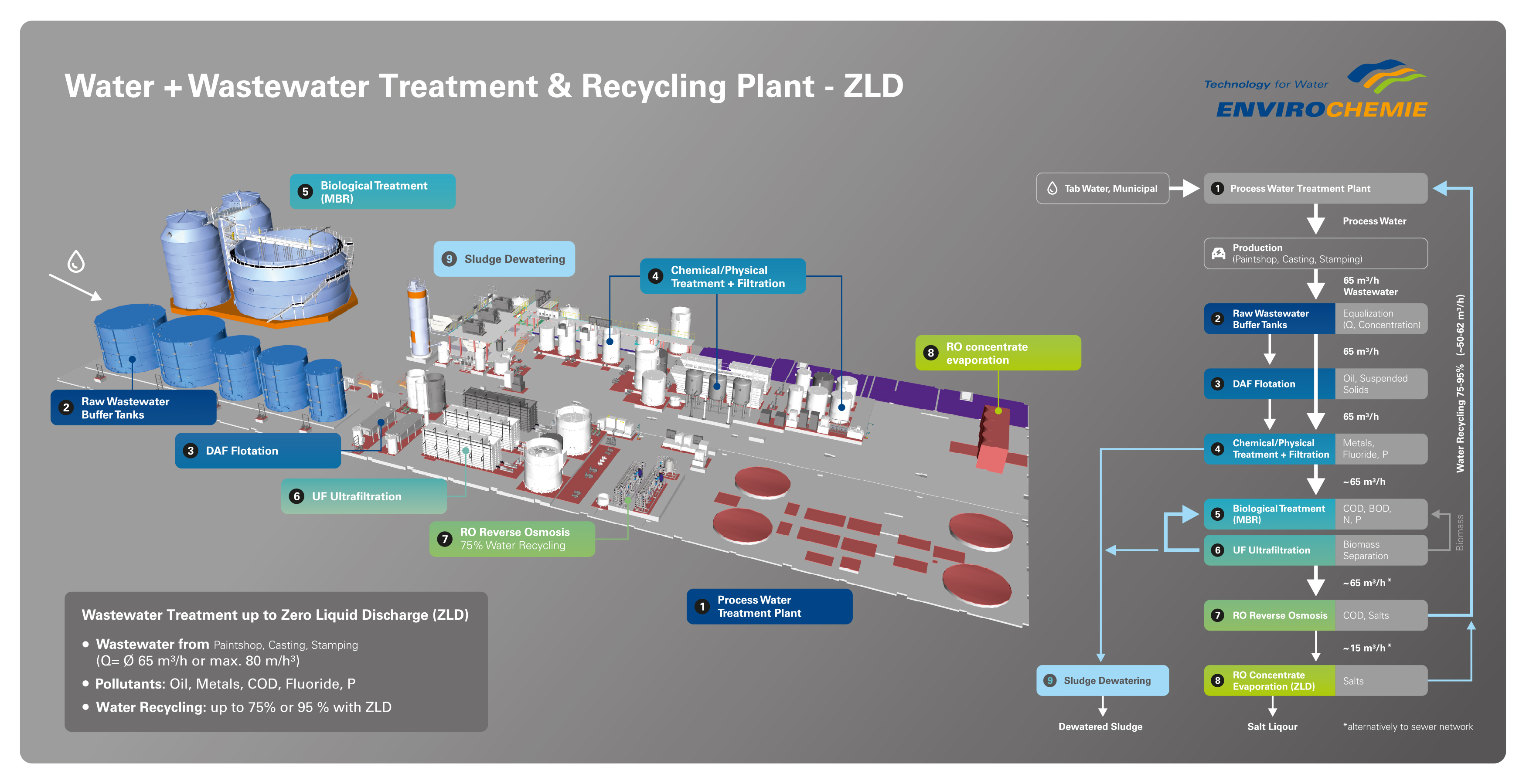
An integrated wastewater treatment and water recycling system was designed and implemented for the entire vehicle production process. The multi-stage solution combines physical, chemical, and biological treatment processes with advanced membrane filtration and is designed for capacities of up to 80 m³/h, handling highly variable industrial loads.

Task

Wastewater from painting, body cleaning, and battery production contains oils, heavy metals, and high organic loads. In addition, pollutant loads fluctuate significantly depending on production capacity. The goal was to ensure reliable compliance with indirect discharge requirements, enable partial reuse of treated water within the production process, and maintain fully automated, stable operation during the ramp-up phase of the site.

Solution

In the pre-treatment stage, dissolved air flotation (Flomar®) reliably removes up to 90% of oils and suspended solids. The downstream chemical-physical stage using Envochem® COL HD efficiently reduces heavy metals and poorly biodegradable substances. In the biological MBR stage (Biomar® OMB), COD is reduced by more than 90%, while ensuring stable effluent quality even during peak loads. Finally, ultrafiltration (Envopur® UF) and reverse osmosis (Envopur® RO) provide multi-stage membrane filtration, delivering consistently high water quality for reuse. Overall, up to 75% of the treated water is recycled back into the production process.

Benefits

The system significantly reduces freshwater consumption while ensuring stable discharge values even under highly variable loads. High recycling rates, efficient COD removal, and automated operation enable resource-efficient and cost-effective water management. Combined with digital monitoring, the result is a transparent, reliable, and future-ready system for sustainable production.

Contact

General contact

General contact

+49 6154 6998 100